

Evolution of Plasmodial Infection Two Years Before, and Three Years after Vector Control, with Four Methods, During A Village Scale Malaria Vector Control Program in Angola
Abstract
Background: Due to P. falciparum drug resistance, and failure of insecticide residual spraying, the National Malaria Control Program selected large-scale distribution of long-lasting insecticide treated nets for vector control, but other tools are needed.
Objective: A village-scale, vector control (VC) program was implemented in eight villages, around Balombo town (Angola), to compare: Long-lasting deltamethrin-treated nets alone; insecticide-treated plastic sheeting (“ITPS”) model “ZeroFly” ® in combination with treated nets; ITPS model “ZeroVector” ® (“ZV”), alone; and ITPS following two rounds of lambdacyhalothrin indoor residual spraying (“IRS”). Each method was implemented in two villages.
Methods: Two years before vector control, and three years after, parasitological cross-sectional surveys (CSS) were done every two months, in each village, on randomly selected symptomless children ≤ 15-year- old. Three indicators were analyzed: plasmodial prevalence (“plasmodic index” PI), parasite load (PL) and gametocyte index (GI).
Finding: 190 field surveys were done; 20,188 thick blood films (TBF) were prepared; Plasmodium were microscopically observed in 5,330 TBF (plasmodial prevalence = 26.4%), and gametocytes in 553 (gametocyte index = 2.74%). P. falciparum was largely preponderant with few P. malariae.
Vector control induced a 70-80% reduction of plasmodial prevalence. Parasite load and gametocyte index were also significantly reduced. The impact was almost similar with the four methods.
Main conclusion: The two models of ITPS could be proposed to the National Malaria Control Program.
Keywords
Angola, Insecticide treated plastic sheeting, Indoor residual spraying, Long lasting insecticide treated nets, Plasmodium prevalence, Parasite load, Gametocytes, Vector control
Introduction
In Angola the whole population (# 40 million) is at-risk of malaria; the burden of this disease is still high with some 10 million of cases and 20.000 deaths per year.
The spread of resistance to antimalarial drugs in Plasmodium in Angola, [1-8] as elsewhere, [9,10] induces a great need for vector control to prevent malaria transmission and reduce incidence rate of malaria morbidity and deaths.
In Angola, indoor residual spraying was stopped due to operational problems [11]. As a result, the National Malaria Control Programme has been based upon the large-cale distribution of long-lasting insecticide-treated nets through various channels. But it has been noticed that, in Balombo, such as elsewhere, in two years, more than 50% of nets become too torn, and are removed.
As new tools for vector control were needed, insecticide-treated plastic sheeting (ITPS), also called wall lining (WL) or durable lining (DL), was recently developed and tested [12] in experimental huts, [13] and successfully used in refugees’ camps, [14-16] and in India [17,18]. Their acceptability was confirmed in Angola, in Huambo, a town close to Balombo, [19] as well as in several other countries in Africa, and in Asia [20], in Papua New Guinea [21].
It was recently highlighted that “there is an urgent need for the development of novel insecticide delivery mechanisms to sustain and consolidate gains in disease reduction and to transition towards malaria elimination and eradication. Insecticide-treated durable wall lining (ITWL) may represent a new paradigm for malaria control as a potential complementary, or alternate, longer-lasting intervention to IRS” and “while some Phase III trials of these products have demonstrated reductions in malaria incidence, further large-scale evidence is still required before operational implementation of ITWL can be considered either in a programmatic or more targeted community context [22].”
A combination of long-lasting pyrethroid-treated nets, (LLIN) and indoor residual spraying (IRS), or durable lining (DL), using another class of insecticide [23,24] was envisaged for insecticide resistance management. It was considered that "implementing IRS in addition to ITNs (= insecticide treated nets) was beneficial for individuals from villages with a wide range of transmission intensities and net utilization levels. Net users received additional protection from IRS. ITNs were providing some individual protection, even in this area with high levels of pyrethroid insecticide resistance. These results demonstrate that there is a supplementary benefit of IRS even when ITNs are effective [25,26]."
For Gimnig, et al. [27] "both IRS and ITNs are effective tools for reducing malaria burden, and, when implemented in an area of moderate to high transmission with moderate ITN coverage, there may be an added benefit of IRS. The value of adding ITNs to IRS is less clear as their benefits may be masked by IRS."
The question of whether, or not, the combination of IRS (or durable lining) and LLIN inside the same house, or village, is measurably better than one method only [28] is still discussed.
To address this question, it was decided, with the National Malaria Control Programme of Angola, to compare the efficacy of classical long-lasting insecticide (deltamethrin) treated nets PermaNet ® 2.0 and lambdacyhalothrin-based indoor residual spraying, with insecticide deltamethrin-treated plastic durable lining (two models, ZeroFly ® and ZeroVector ® ) used alone, or in combination with LLIN, or following two rounds of IRS.
The project, scheduled on a long-term basis, included a comprehensive evaluation, with three steps: i) first five years, considering eight villages (two for each vector control method) with entomological, parasitological and immunological evaluation; ii) then five years more, considering the long-term evolution of the parasitological situation in four villages (one for each method); and, iii) 11 years after the beginning of the study, another parasitological cross-sectional survey of the eight villages to check for any rebound after implementation of vector control.
The area was already presented [29,30]. Balombo is located in the South of the inland plateau, a mountainous (# 1,000 -1,200 m altitude) and volcanic area where trees were cut for agricultural purposes. The climate is sub-tropical. The rainfall is around 1,000 -1,300 mm mainly in January, February, March- April; then October, November, December. From May to August-September, it is called dry-cold season.
The immunological evaluation was based on the evolution of anti-saliva IgG in children 2-9-year-old between 2008 (one year before vector control) and 2009 (one year after vector control). This approach showed that the three methods reduced significantly anopheles-contact in children with, apparently, a better impact obtained with IRS [29].
First entomological evaluation was based on regular surveys, done systematically during five years (two years before vector control and three years after), two weeks before parasitological surveys and with CDC Light Trap inside houses. It was observed an overall reduction of 83% of the entomological inoculation rate (EIR) after implementation of vector control [30].
The impact on the EIR appeared different according to the vector control implemented: -62.7% with LLINs alone; -80.6% with the association LLIN+DL ZF; -81.1% with DL ZV alone and -81.3 with IRS followed by DL installation [30].
Materials and Methods
Demographic, and geographic situation
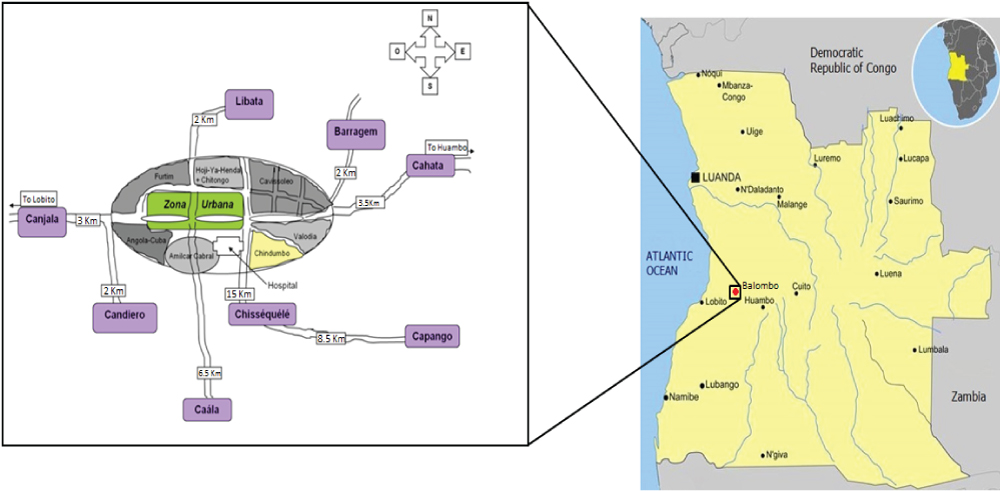
The National Malaria Control Programme (NMCP) selected eight villages in the Balombo municipality in the Benguela Province of central Angola (12°21’S; 14°46’E, altitude 1,203 m), 150 km east of Lobito town and 600 km southeast of Luanda, the national capital (Map).
Before the trial, a comprehensive census was done in each village by the village health worker who noticed the family composition in each house which received, for identification, a number written on the door, then geolocalization with GPS.
The program included initially 5,411 people in 1,617 houses (# 3.3 inhabitants per house) and 2,684 sleeping units.
Tools for vector control
Four tools were used for vector control:
• Long-lasting insecticide-treated nets (LLIN), model PermaNet ® 0, treated at 55 mg a.i. deltamethrin (δ)/m 2 ; with a surface of 13 m 2 , the total amount of insecticide was 0.715 gr a.i. deltamethrin/LLIN.
• Insecticide-treated durable lining (DL), model “ZeroVector” ® , treated at 170 mg a.i. δ/m 2 and presented as roll.
• Insecticide-treated durable lining (DL), model ZeroFly ® , treated at 360 mg a.i. δ/m 2 ; with a size of 19.11 m 2 , the total amount of insecticide was 6.88 gr a.i. δ/ ZeroFly ® .
• Sachets of lambdacyhalothrin (λ) Icon ® WP, 6.25 gr a.i. λ/sachet for indoor residual spraying, targeting 25 mg a.i./m 2 of sprayed surface, two rounds, followed by installation of DL.
Vector control operations (VCOp)
LLINs, model PermaNet ® 2.0, only, were distributed in two villages, (Caala and Cahata).
In Caala, 636 LLINs were distributed for 239 houses and 469 sleeping units, while in Cahata, 530 LLINs were distributed for 154 houses and 442 sleeping units. These distributions were considered as having get the full coverage of the entire population. Distribution of nets started in February 2007 to get one net per house. Another distribution was done in February 2008, and completed in December 2008, to achieve full coverage, defined as one net per sleeping unit.
Deltamethrin-treated durable lining, model “ZeroFly ® , (“δZF”), in combination with LLIN, were installed in two villages (Capango and Canjala).
Deltamethrin-treated durable lining model ZeroVector ® , (δDL), alone, was installed in two villages (Chisséquélé and Barragem).
Following two rounds of lambdacyhalothrin indoor residual spraying, (λIRS); DL was implemented in two villages (Candiero and Libata).
The implementation of the association LLIN + ZeroFly ® ; of DL ZeroVector ® alone; and the first round of IRS were completed in December 2008. The second round of IRS was performed in June 2009, and installation of DL in January 2010 (one model of DL in each village).
Therefore, the first two years, two villages received LLIN, while six villages remained as control, and the period was called “before vector control” for them. The following three years, the eight villages had all received vector control, and the period was called “after vector control.”
The details of these Vector Control Operations were already presented as well as entomological data [29,30].
Parasitological protocol
The parasitological evaluation of vector control was based upon cross-sectional surveys (CSS) performed every two months, two weeks after entomological surveys, following the protocol implemented in Côte d’Ivoire to study the efficacy of lambdacyhalothrin-treated nets in area where the local vector ( An. gambiae ) had a high level of kdr-based insecticide resistance.
Each parasitological survey was conducted on a randomized sample of symptomless children ≤ 15-year-old, chosen according to the number of each house written on the door, and selected with Ran function of Excel.
Classical thick blood films (TBF) were done, and colored, in the field, then examined with light microscope in the medical department of the Sonamet ® Company in Lobito, which had implemented a “Malaria Control Programme (MCP)”. The Balombo Project was a component of MCP activities. 10% of the slides were double-checked in OCEAC Yaoundé laboratory.
During the field survey almost all the population of the village came for having a blood test for malaria. But to allow a correct comparison between situations, “here and there” and “before vs. after,” only results of thick blood films (TBF) of children ≤ 15-year-old were statistically analyzed. A previous analysis of parasitological surveys done in villages before implementation of vector control showed that this sample was relevant, and similar to the data of classical “at-risk” group (0-5 years) or 2-9-year-old, (used for endemicity classification) [31].
All blood films done during the field survey were examined, and results were given to the primary health care worker of each village for action, in accordance with the National Malaria Control Program recommendations.
Three indicators were considered: Plasmodium prevalence (also called plasmodial prevalence or parasite index), parasite load (PL, also called parasitaemia), and gametocyte index (GI) for the analysis of the parasitological impact of vector control.
The impact of vector control methods on parasite load was analyzed at two levels: the percentage of parasite load higher than 1,000 par./ml (compared with the classical Chi-square) and an analysis of the median, using the Mann-Whitney nonparametric test.
The study was done in completely natural conditions, inhabitants engaged in their usual way of life, farmers went to their fields each morning and returned to the village at dusk.
Results
Overall parasite index
190 cross-sectional-surveys were regularly performed, during five years. P. falciparum was largely predominant. Very few cases of P. malariae were diagnosed (22 alone and 44 in association with P. falciparum ). Therefore, analysis of data considered all plasmodial infections together.
In the sample of symptomless children ≤ 15-year-old, trophozoites of Plasmodium were microscopically noticed in 5,330 of the 20,188 thick films done, i.e. an overall parasite index of 26.4% (Table 1) and gametocytes were noticed in 553 thick films, i.e. an overall gametocyte index of 2.73%.
Yearly evolution of parasite index according to village and implementation of vector control
• Yearly evolution of parasite index according to village
Data describing the results of microscopic examination of thick blood films for every village, and every year, are gathered in (Table 1).
The first year of the trial, before any intervention, approximately 50% of symptomless children were Plasmodium carriers; three years after vector control, the parasite index dropped to some 5.8%, and the decrease was observed everywhere.
Actually, from 2007 to 2011, the parasite index dropped by 71.6% in Caala; 91.3% in Cahata; 91% in Capango; 89.9% in Canjala; 86.9% in Chisséquélé; 89.8% in Barragem; 90.7% in Candiero; and 91.9% in Libata, giving an overall decrease of parasite index of 88.2% in five years.
• Yearly evolution of parasite index (PI) according to the vector control method implemented
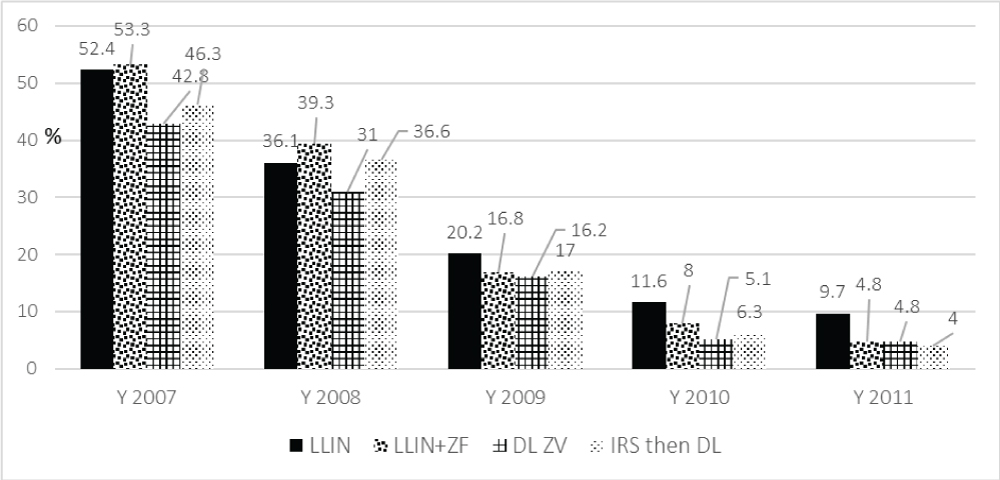
Data describing the evolution of the plasmodial prevalence according to the vector control method implemented are gathered in (Table 2).
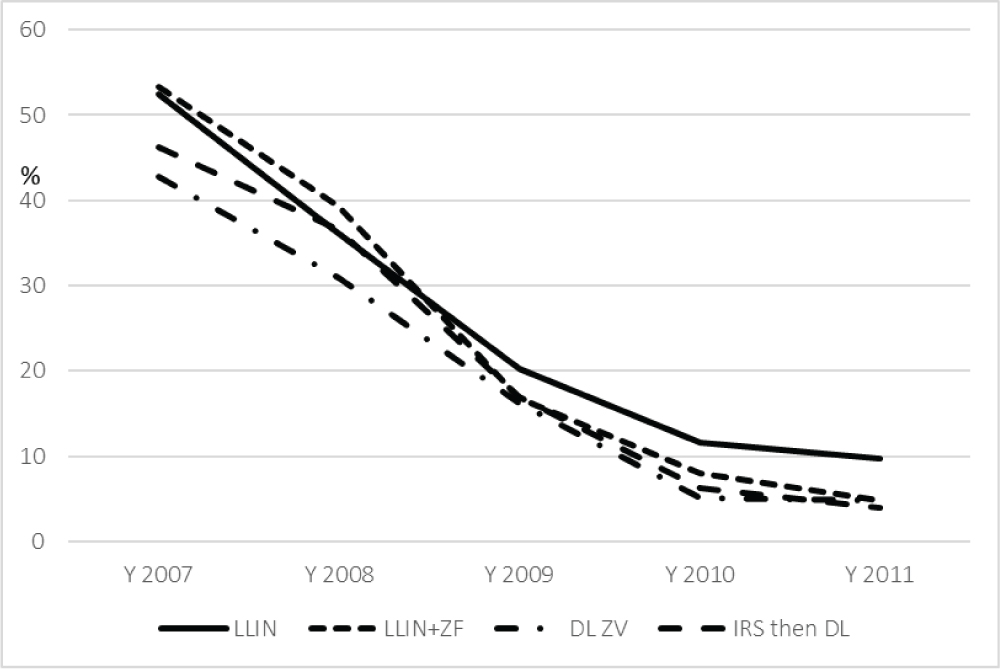
The trends in the evolution of the parasite index according to the vector control method implemented appeared remarkably similar (Figure 1).
From Table 2 it is possible to evaluate the reduction of the plasmodial prevalence from year 2007 to year 2011 according to the vector control method implemented: - 81.5% with LLIN; - 90.6% with the combination of LLIN and ZeroFly ® ; -88.8% with durable lining ZeroVector ® alone; and -91.4% with two rounds of IRS followed by durable lining installation.
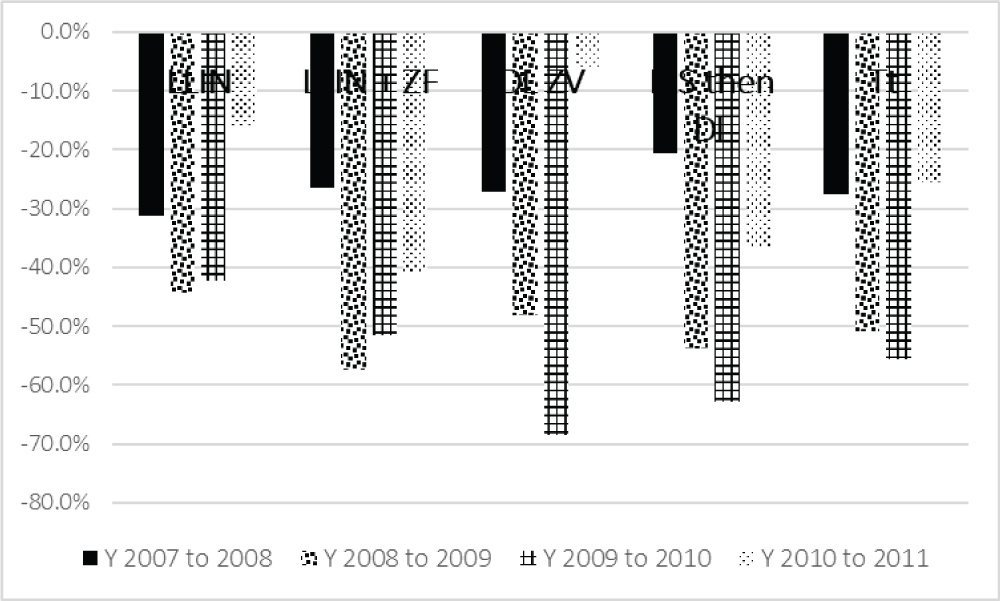
The decrease, from year to year, of the plasmodial prevalence was observed for each method of vector control (Figure 2); even with some different levels (Table 3).
Before vector control: the first two years (2007-2008), the parasite index decreased significantly, by 31.1% in the villages furnished with LLIN (χ 2 = 84.1; OR = 0.51 [0.44-0.59]). But, significantly also, in control villages: By 26.5% (χ 2 = 41.5; OR = 0.56 [0.47-0.67]) in the two villages which were to receive the combination of LLIN and ZeroFly ® ; by 27.1% (χ 2 = 0.61 [0.50-0.73]) in the two villages which would receive durable lining ZeroVector ® only; and by 20.5% (χ 2 = 0.67 [0.57-0.79]) in the two villages which were to receive IRS then durable lining.
Considering the six villages, without organized vector control, the parasite index significantly decreased by 25%; from 47.7% (n = 2,647) to 35.7% (n = 4,040) (χ 2 = 95.1; OR = 0.61 [0.55-0.67]).
After vector control: the first year after vector control implementation (year 2009), the reduction was always striking: -44% after coverage with LLIN; -57% with the combination of LLIN and ZeroFly ® ; -48% with durable lining alone; -54% with two rounds of IRS, and 51% for the eight villages together.
The second year after vector control implementation (year 2010), the high level of reduction was maintained: -42% with LLIN; -51% with the combination of LLIN and ZeroFly®; -68.5% with durable lining ZeroVector ® -63% after IRS followed by durable lining; and -56% for the group of villages.
The third year after vector control (2011) some fading of the efficacy was noticed, with LLIN alone (-16%) and durable lining alone (-6%), while the parasite index was still greatly reduced in villages with the combination of LLIN and ZeroFly ® (-41%) and with durable lining installed after two rounds of IRS (-36%).
For the eight villages gathered, the quick decrease in parasite index over the years was spectacular (Figure 3), with a relative 50.8% decrease the first year after vector control, between 2008 (PP = 35.8%) and 2009 (PP = 17.6%); then another 55.7% decrease the second year, between 2009 and 2010 (PP = 7.8%); but the efficacy seemed having been reduced the third year with a relative 25.6% diminution in 2011 (PP = 5.8%) similar to the 27.7% decrease observed the first two years without any intervention.
Overall evolution of parasite index before vs. after implementation of vector control: Two main periods were considered: Two years “before,” and three years “after.”
• Evolution according to village
Evolution of parasite index in each village is reported in (Table 4).
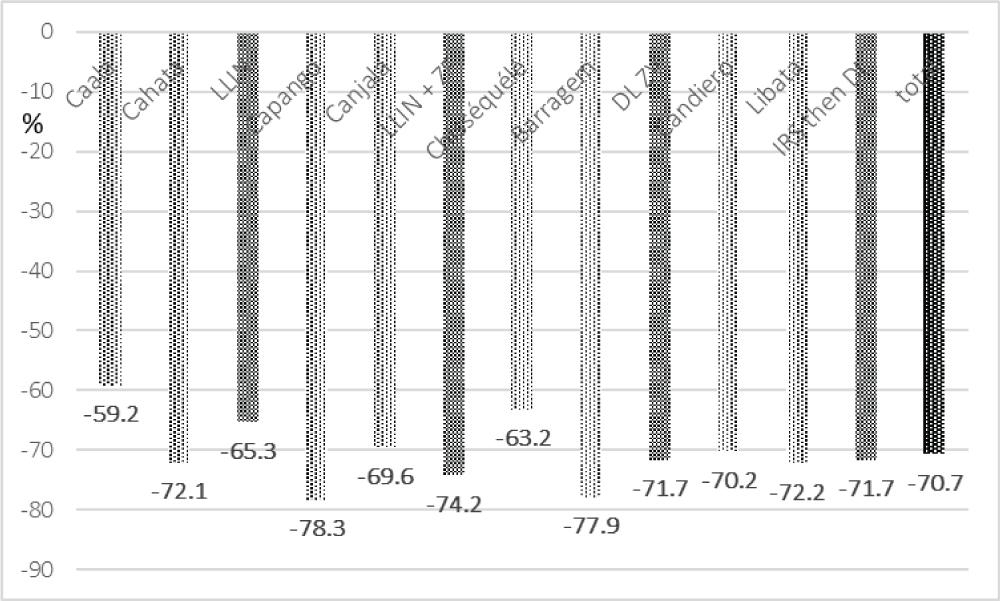
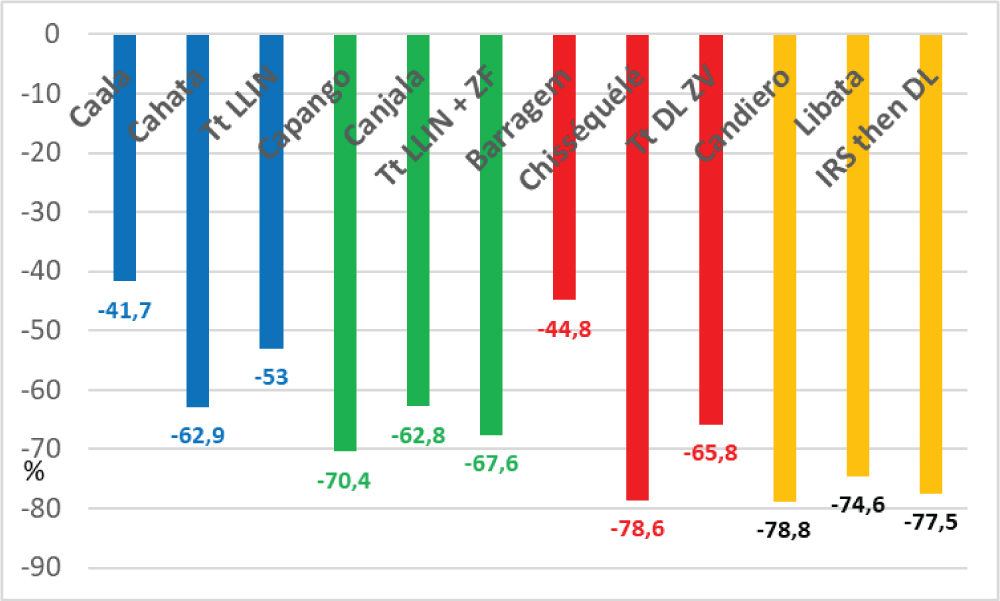
There appeared to be a decrease in every village (Figure 4) which was different according to village, from -60% (Caala) to -80% (Barragem), and a remarkable similarity in the two villages with IRS then durable lining; the observed overall reduction was -71% (Figure 5).
• Evolution according to method of vector control
Every method of vector control reduced significantly the parasite index (Table 5).
Comparing the situation before vector control, and after full implementation of every method of vector control, there clearly appeared to be a strong, and similar, reduction of some 70% (± 5%) of the prevalence of Plasmodium in symptomless children examined.
Evolution of parasite load
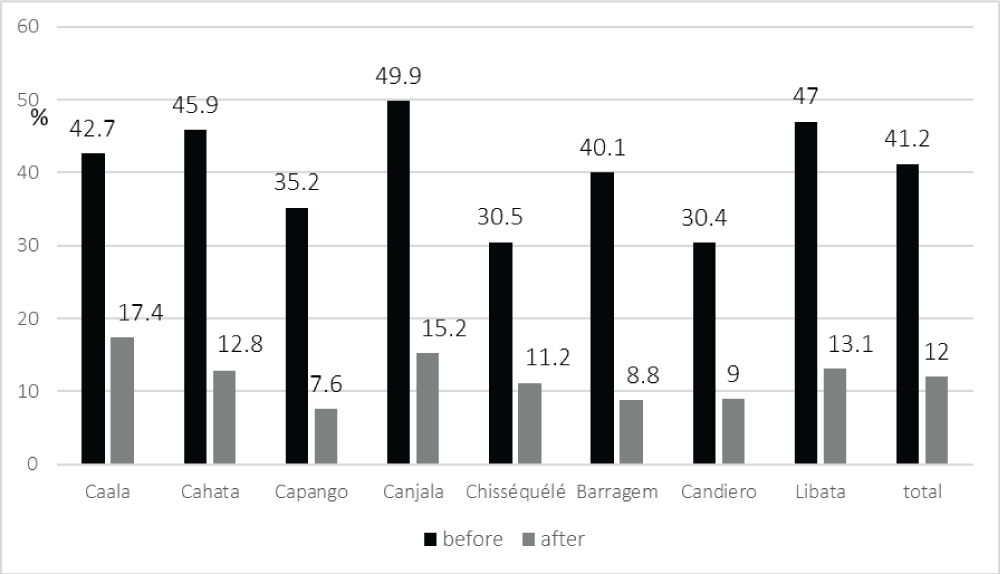
Parasite load ≥ 1,000 par./ml : The impact of each one of the four methods of vector control on parasite load higher than the classical threshold of 1,000 par./ml is reported in (Table 6).
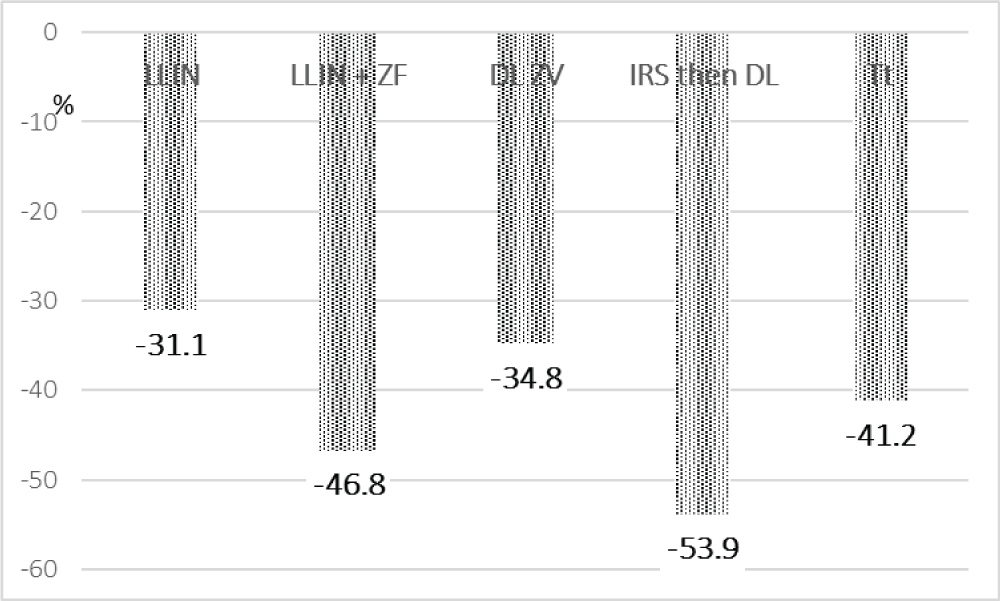
Each vector control method implemented induced a significant reduction of parasite load ≥ 1,000 par./ml with an average of 41.2% (Figure 6). This percentage varied slightly according to the method: -30.1% with LLIN alone; -43.0% with the combination of LLIN and ZF; -34.8% with durable lining ZeroVector ® alone; -53.9% with IRS followed by durable lining.
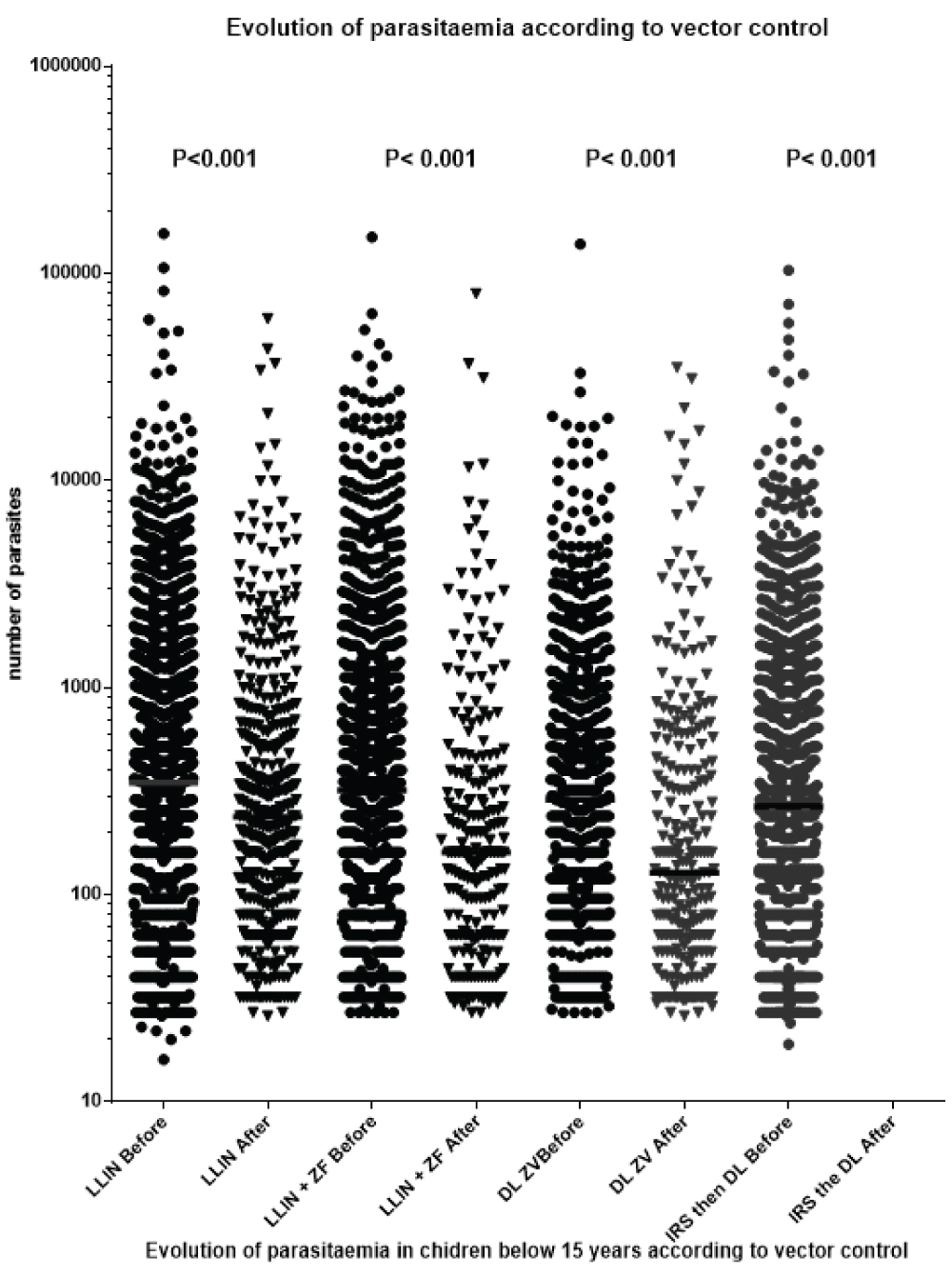
Evolution of parasite load according to vector control: The dispersion of parasite load was very large, from 20 to more than 100,000 par./ml. The statistical analysis of parasite counts in each thick blood film “before” vs. “after” vector control showed that each method significantly reduced the parasite load of symptomless children ≤ 15-year-old (Figure 7).
Evolution of gametocyte index
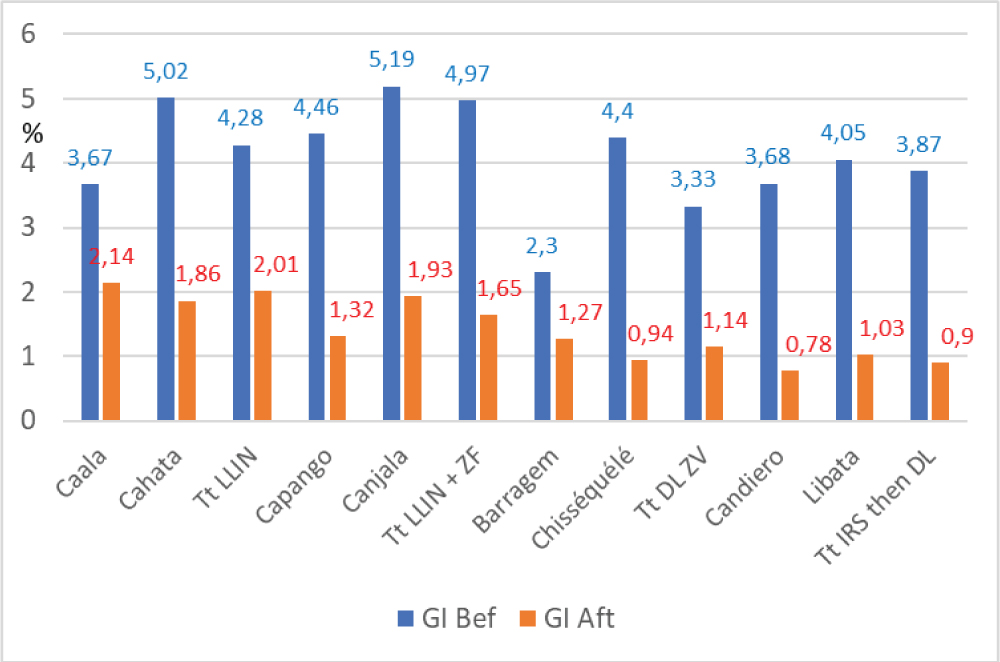
Evolution of gametocyte index: Gametocytes were noticed in 553 of the 20,188 thick films made during the study, i.e., an overall gametocyte index of 2.74%. There was a significant reduction of -66.3% (from 4.16% to 1.40%) (χ 2 = 143; OR = 0.33 [0.27-0.39]) after implementation of vector control methods (Table 7).
Vector control induced sharp reductions of gametocyte index in each village (Figure 8a).
These reductions occurred with every method implemented and, in each village, with great variations, from -40% (Caala, LLIN alone; Barragem: DL ZeroVector ® alone) to -80% in villages with DL ZeroVector ® alone (Chisséquélé) or IRS then DL (Candiero) (Figure 8b).
The decrease in the gametocyte index was statistically significant in villages with LLIN alone (χ 2 = 24.17; p < 0.005; OR = 0.46 [0.33-0.64]); in villages with LLIN and ZeroFly ® (χ 2 = 40.45; p < 0.005; OR = 0.32 [0.21-0.47]); in villages with durable lining alone (χ 2 = 26.99; p < 0.005; OR = 0.33 [0.21-0.51]); in villages with IRS then installation of durable lining (χ 2 = 54.7; p < 0.005; OR = 0.22 [0.14-0.34]); and for all eight villages considered together.
Concomitant evolution of parasite index and gametocyte index: The decreases in the gametocyte index and parasite index were consistent (Table 8).
The vector control implemented induced an overall reduction of some 70% of these parasitological indicators.
Synthesis, concomitant evolution of entomological and parasitological parameters
Entomological [30] and parasitological data, obtained by field surveys carried out at the same time, during the first five years of the project, are remarkably consistent (Table 9).
Parasitological data were well in line with the entomological data comparing the simultaneous evolution of both the entomological inoculation rate (EIR), presented previously [30], and the parasite index (PI) after implementation of every vector control method:
- with LLIN alone, the entomological inoculation rate (h) decreased by 63% and the parasite index by 65%;
- with the combination of LLIN and ZeroFly ® , the inoculation rate decreased by 80.6% and the parasite index by 75%;
- with DL ZeroVector ® alone, the inoculation rate decreased by 81% and the parasite index by 72%;
- with IRS followed by durable lining, the inoculation rate decreased by 81.3% and the parasite index by 73%.
For all eight villages gathered, the inoculation rate decreased by 83% and the parasite index by 71%.
Discussion
As well underlined by Chaccour, et al. [32] "most of the reduction in malaria prevalence seen in Africa since 2000 has been attributed to vector control interventions. Yet increases in the distribution and intensity of insecticide resistance and higher costs of newer insecticides pose a challenge to sustaining these gains. Thus, endemic countries face challenging decisions regarding the choice of vector control interventions." According to Bhatt, et al. [33] “ Plasmodium falciparum infection prevalence in endemic Africa halved and the incidence of clinical malaria fell by 40% between 2000 and 2015. We estimate that malaria control interventions have averted 663 (542-753) million clinical cases since 2000, of which 68 (62-73) %, 22 (17-28) % and 10 (5-14) % were contributed by ITNs, ACT, and IRS, respectively.”
"Nets, spray or both?" was the question raised [34], and several studies were devoted to this issue [25,26,35-42], but with inconsistent data, and different conclusions.
The Balombo project was planned, and implemented, as a comprehensive, long-term village-scale malaria control trial, to compare the epidemiological efficacy of durable lining, alone, or associated with treated nets, or following house spraying, while long lasting insecticide treated nets were considered as the “golden standard”. The project was carried out in completely natural conditions. Information gained were given to the National Malaria Control Program to select appropriate, adapted tools for vector control, as additions to its other services, including quick diagnosis with RDT, case management with ACT, intermittent presumptive treatment for pregnant women etc.
Several studies were devoted to durable lining, mainly dealing with entomological impact [13,17,20,41,43-50], while few studies dealt with parasitological impact.
In Liberia [51], it was noticed that “ Plasmodium falciparum prevalence on active clusters [i.e. with LLIN alone or with durable wall lining ‘DWL’ after 12 months was 34.6% compared to 40.1% in control clusters (p = 0.052)” with the conclusions that “DWL is a scalable and effective malaria control intervention in stable transmission area with pyrethroid-resistant vectors, where LLIN usage is difficult to achieve.”
In two refugees’ camps in Sierra-Leone, “insecticide-treated plastic sheeting (ITPS) and untreated polyethylene sheeting (UPS) were randomly deployed” in two camps, Largo and Tobanda, with two kinds of coverage inside the houses. Checking “the Plasmodium falciparum incidence rate in children up to 3 years of age who were cleared of parasites and monitored for 8 months” it was considered that the “protective efficacy was 61% under fully lined ITPS and 15% under roof lined ITPS [16].”
This level of 61% could be compared to the 71% reduction of plasmodial prevalence in the Balombo trial.
After the difficulties in organizing the first indoor spraying program against malaria in Angola [11], this method was stopped, and replaced by large-cale distribution of long-lasting insecticide-treated nets. However, observed withdrawal of nets, in Balombo villages, reached more than 50% in two or three years [52,53], which left people with little, if any, protection. Unrepaired torn impregnated mosquito nets were noticed outside human houses, discarded, here and there, in the villages, or misused for several, unexpected, purposes.
On the other hand, some recent studies showed that there was great community acceptance of insecticide-treated wall lining in Huambo [19], a town close to Balombo, as in several places elsewhere [20,21]. But, in some villages around Balombo, it was observed that, quite often, some pieces of insecticide-treated plastic durable lining were cut into strips to make clotheslines, or in pieces to protect young trees from goat etc. This human behavior had an entomological and parasitological influence, with, both, a small increase of mosquito densities the third year after vector control and a smaller reduction of parasite index after the initial two years great decrease.
The first five years' parasitological evaluation, presented here, and in complement to the entomological evaluation presented previously [30], was based upon classical random cross-sectional surveys (CSS) performed every two months, in the field, dealing with symptomless ≤ 15-year-old children. During the 190 field surveys, a total of 20,188 thick blood films was done. Their examination, by light microscope, showed an overall Plasmodium prevalence of almost 50% before any intervention. Since Boyd [54], it is well-known that a prevalence of 50% means that everyone is infected (was or will be infected) and indicates the endemic character of malaria in the area. Such plasmodial prevalence underlines the need for large-scale vector control considering the worsening issue of drug-resistance in the country.
Analyses of data obtained during these first five years, with three parasitological indicators (parasite index, parasite load, and gametocyte index), showed that, after vector control implementation, the four methods had similar parasitological efficacy inducing:
- A sharp, and statistically significant, reduction of parasite index, from 50% before any intervention to less than 5% the third year after vector control implementation;
- A significant reduction of 70% of parasite index comparing the two years “before” to the three years “after” vector control;
- A significant reduction (40 ± 10%) of parasite load ≥ 1,000 par./ml; the highest reduction was obtained when two rounds of IRS were followed by durable lining installation; then with the combination of LLIN and ZeroFly ® which seemed to have been higher than LLIN or durable lining alone;
- A significant reduction of parasite load, a crucial epidemiological information considering the importance of parasite load in diagnosis of malaria, and in clinical illness [55-57]. On the other hand, it is worth noticing these heavy loads of Plasmodium in clinically symptomless children.
- A two-thirds reduction of human gametocyte carriers, e., infectivity for vectors; adding LLIN and durable lining did not induce a spectacularly greater impact on gametocyte index in this trial. Relatively greater effect was obtained with two rounds of lambdacyhalothrin IRS followed by the installation of deltamethrin-treated plastic durable lining.
The consistency of the entomological and parasitological data, gained with field surveys performed simultaneously during five years, underlines the importance of such evaluation combining the two approaches for a better assessment of the effectiveness of vector control operations [58].
Actually, durable lining alone, or in combination with LLIN or following two rounds of indoor spraying, induced a similar reduction of the entomological inoculation rate, by 80%, and a similar reduction of parasite index, by 70%, comparable to the 65% induced by LLIN.
In fact, “overall, the trans-disciplinary cooperation among parasitologists and entomologists is crucial to ensure proper evaluation of the epidemiological impact triggered by novel mosquito vector control strategies [59].”
From both entomological, and parasitological analyses, the three methods of vector control using durable lining, implemented during the first phase of Balombo project appeared to have had comparable impact. Immunological analyzes reported that “the levels of anti-saliva IgG Ab were most reduced when LLIN and ITPS-ZF were used in combination, compared to the use of one vector control method alone, either ITPS-DL or IRS [29].”
These interesting conclusions underline the importance of main indicators selected to evaluate the efficacy of the vector control methods.
The protocol, and the data gained during this comprehensive, long-term, village-scale, vector control program around Balombo town, are useful for the implementation, monitoring, and evaluation of the vector component of the National Malaria Control Program.
Conclusion
It was worth trying the recently developed deltamethrin-treated plastic durable lining, which could be considered as a new tool in the arsenal of the National Malaria Control Program targeting the elimination of malaria. This new tool has the advantage of being as efficient as classical LLIN and IRS, but with longer-lasting efficacy and actual community participation, a “sine qua non” condition for the success of vector control efforts. The trends of parasitological data were in full agreement with the entomological data, with an 80% reduction of transmission and 70% of malaria parasite index, and an important, and significant decrease of the parasite load, in symptomless children.
Therefore “insecticide-treated durable wall lining (ITWL)” may represent a new paradigm for malaria control as a potential complementary or alternate longer-lasting intervention to IRS [22].”
Authors Contributions
PC designed the protocol, participated in field surveys, analyzed data, and wrote the initial manuscript; JCT and VF participated in field surveys and blood slides examination; FF was involved in field surveys and monitoring the programme; FM was the MD of the Medical Dept. of Sonamet ® managing MCP programme and agents involved in blood slides examination; GC was involved in the final writing and editing of the document.
Acknowledgments
Many thanks to the Direction of the Sonamet ® Company of Lobito, Angola, and the agent of his medical department, for their permanent and important support through their Malaria Control Programme (MCP), and to the SubSea ® 7 Company for its crucial and constant support.
Many thanks also to the Ministry of Health, the National Malaria Control Programme and the Provincial Public Health Department, which allowed and were involved in the study, and provided important help in solving many issues related to the field trials.
Many thanks also to the communities of the eight villages who were directly involved in various vector control activities.
Many thanks to Mr. Timelman who procured the tools for vector control.
Many thanks to Teacher John for his proof reading and editing.
Funding
The studies were supported by the Sonamet ® Company of Lobito, Angola, and the SubSea ® 7 company of London.
Declaration of Competing Interest
The authors declare that they have no competing interest.
Ethics Statement
This study was conducted in accordance with the Edinburgh revision of the Helsinki Declaration and was approved by, and done with, the National Malaria Control Program of the Ministry of Health of Angola, the Ethical authority in charge of approving studies on malaria research in Angola.
It was a component of the ongoing Malaria Control Program (MCP) of the Medical Department of the Angolese SONAMET ® Company.
Authors confirmed no use of a.i. in this document.
References
- Olsen V, Jensen T, Jorgensen M (1984) Chloroquin-resistant Plasmodium falciparum malaria from Angola. Lancet 1: 1462-1463.
- Lindberg J, Sandberg T, Bjorkholm B, et al. (1985) Chloroquine and Fansidar ® resistant malaria acquired in Angola. Lancet 1 :765.
- Pimentel S, Nogueira F, Benchimol C, et al. (2006) Detection of atovaquone-proguanil resistance conferring mutations in Plasmodium falciparum cytochrome b gene in Luanda, Angola. Malar J 5: 30.
- Escobar C, Pateira S, Lobo E, et al. (2015) Polymorphisms in plasmodium falciparum K13-propeller in Angola and Mozambique after the introduction of the ACTs. PLoS One 10: e0119215.
- Fortes F, Dimbu R, Figueiredo P, et al. (2011) Evaluation of prevalence's of pfdhfr and pfdhps mutations in Angola. Malar J 10: 22.
- Gama B, Pereira Carvalho G, Lutucuta Kosi F, et al. (2011) Molecular markers of antifolate resistance in Plasmodium falciparum isolates from Luanda, Angola. Malar J 10: 248.
- Suleimanov S (1994) Drug-resistant tropical malaria in Angola. Med Parazitol (Mosk) 2: 8-10.
- Fançony C, Brito M, Gil J (2016) Plasmodium falciparum drug resistance in Angola. Malar J 15: 74.
- Rasmussen C, Alonso P, Ringwald P (2022) Current and emerging strategies to combat antimalarial resistance. Expert Rev Anti Infect Ther 20: 353-372.
- WHO (2020) Report on antimalarial drug efficacy, resistance and response: 10 years of surveillance (2010-2019). World Health Organization 78.
- Somandjinga M, Lluberas M, Jobin W (2009) Difficulties in organizing first indoor spray programme against malaria in Angola under the President's Malaria Initiative. Bull Wld Hlth Org 87: 871-874.
- Diabate A, Chandre F, Rowland M, et al. (2006) The indoor use of plastic sheeting pre-impregnated with insecticide for control of malaria vectors. Trop Med Int Health 11: 597-603.
- Chandre F, Dabire R, Hougard J, et al. (2010) Field efficacy of pyrethroid treated plastic sheeting (durable lining) in combination with long lasting insecticidal nets against malaria vectors. Parasit Vectors 3: 65.
- Graham K, Mohammad N, Rehman H, et al. (2002) Insecticide-treated plastic tarpaulins for control of malaria vectors in refugee camps. Med Vet Entomol 16: 404-408.
- Burns M (2005) Evaluating insecticide-treated polyethylene sheeting for malaria control in complex emergencies: An intersectoral approach. Humanitarian Exchange 31: 14-16.
- Burns M, Rowland M, N'guessan R, et al. (2012) Insecticide-treated plastic sheeting for emergency malaria prevention and shelter among displaced populations: An observational cohort study in a refugee setting in Sierra-Leone. Am J Trop Med Hyg 87: 242-250.
- Mishra A, Bharti P, Kareemi T, et al. (2019) Field evaluation of Zero Vector® durable lining to assess its efficacy against malaria vectors and malaria transmission in tribal areas of the Balaghat district of central India. Trans R Soc Trop Med Hyg 113: 623-631.
- Mittal P, Sreehari U, Razdan R, et al. (2011) Evaluation of the impact of ZeroFly®, an insecticide incorporated plastic sheeting on malaria incidence in two temporary labor shelters in India. J Vector Borne Dis 48: 138-143.
- Messenger L, Miller N, Adeogun A, et al. (2012) The development of insecticide-treated durable wall lining for malaria control: Insights from rural and urban populations in Angola and Nigeria. Malar J Sep 18: 332.
- Messenger L, Matias A, Stiles Ocran J, et al. (2012) Multicentre studies of insecticide-treated durable wall lining in Africa and South-East Asia: Entomological efficacy and household acceptability during one year of field use. Malar J 11: 358.
- Pulford J, Tandrapah A, Atkinson J, et al. (2012) Feasibility and acceptability of insecticide-treated plastic sheeting (ITPS) for vector control in Papua New Guinea. Malar J 11: 342.
- Messenger L, Rowland M (2017) Insecticide-treated durable wall lining (ITWL): future prospects for control of malaria and other vector-borne diseases. Malar J 16: 213.
- Djènontin A, Chabi J, Baldet T, et al. (2009) Managing insecticide resistance in malaria vectors by combining carbamate-treated plastic wall sheeting and pyrethroid-treated bed nets. Malar J 8: 233.
- Djènontin A, Chandre F, Dabiré K, et al. (2010) Indoor use of plastic sheeting impregnated with carbamate combined with long-lasting insecticidal mosquito nets for the control of pyrethroid-resistant malaria vectors. Am J Trop Med Hyg 83: 266-270.
- West P, Protopopoff N, Wright A, et al. (2015) Enhanced protection against malaria by indoor residual spraying in addition to insecticide treated nets: Is it dependent on transmission intensity or net usage? PLoS One 10: e0115661.
- West P, Protopopoff N, Wright A, et al. (2014) Indoor residual spraying in combination with insecticide-treated nets compared to insecticide-treated nets alone for protection against malaria: A cluster randomised trial in Tanzania. PLoS Med 11: e1001630.
- Gimnig J, Otieno P, Were V, et al. (2016) The effect of indoor residual spraying on the prevalence of malaria parasite infection, clinical malaria and anemia in an area of perennial transmission and moderate coverage of insecticide treated nets in western kenya. PLoS One 11: e0145282.
- Protopopoff N, Wright A, West P, et al. (2015) Combination of insecticide treated nets and indoor residual spraying in northern tanzania provides additional reduction in vector population density and malaria transmission rates compared to insecticide treated nets alone: A randomised control trial. PLoS One 10: e0142671.
- Brosseau L, Drame P, Besnard P, et al. (2012) Human antibody response to Anopheles saliva for comparing the efficacy of three malaria vector control methods in Balombo, Angola. PLoS One 7: e44189.
- Carnevale P, Toto JC, Foumane V, et al. (2002) The durable lining: A new tool for malaria vector control compared to other classical methods (Long-Lasting Insecticide Treated Nets “LLIN”) during a village-scale long-term trial in angola. I. Entomological Evaluation. MedPress, Public Hlth & Epidemiology 2.
- Carnevale P, Dos Santos M, Moniz Soyto A, et al. (2018) Parasitological surveys on malaria in rural balombo (Angola) in 2007-2008. Base line data for a malaria vector control project. Int J Trop Dis 31: 1-12.
- Chaccour C, Alonso S, Zulliger R, et al. (2018) Combination of indoor residual spraying with long-lasting insecticide-treated nets for malaria control in Zambezia, Mozambique: A cluster randomized trial and cost-effectiveness study protocol. BMJ Glob Health 3: e000610.
- Bhatt S, Weiss D, Mappin B, et al. (2015) Coverage and system efficiencies of insecticide-treated nets in Africa from 2000 to 2017. Elife 4: e09672.
- Fullman N, Burstein R, Lim S, et al. (2013) Nets, spray or both? The effectiveness of insecticide-treated nets and indoor residual spraying in reducing malaria morbidity and child mortality in sub-Saharan Africa. Malar J 12: 62.
- Corbel V, Akogbeto M, Damien G, et al. (2012) Combination of malaria vector control interventions in pyrethroid resistance area in Benin: a cluster randomized controlled trial. Lancet Infect Dis 12: 617-626.
- Pinder M, Jawara M, Jarju L, et al. (2015) Efficacy of indoor residual spraying with dichlorodiphenyltrichloroethane against malaria in Gambian communities with high usage of long-lasting insecticidal mosquito nets: A cluster-randomized controlled trial. Lancet 385: 1436-1446.
- Kafy H (2013) Combination of IRS with LLINs versus LLINs alone in Sudan: Results of a very large randomised trial. 6 th MIM Pan-African Malaria Conference, Durban, South Africa, 6-11.
- Hamel M, Otieno P, Bayoh N, et al. (2011) The combination of indoor residual spraying and insecticide-treated nets provides added protection against malaria compared with insecticide-treated nets alone. Am J Trop Med Hyg 85: 1080-1086.
- Okumu F, Mbeyela E, Lingamba G, et al. (2013) Comparative field evaluation of combinations of long-lasting insecticide treated nets and indoor residual spraying, relative to either method alone, for malaria prevention in an area where the main vector is Anopheles arabiensis. Parasit Vectors 6: 46.
- Ngufor C, N'Guessan R, Boko P, et al. (2011) Combining indoor residual spraying with chlorfenapyr and long-lasting insecticidal bed nets for improved control of pyrethroid-resistant Anopheles gambiae: An experimental hut trial in Benin. Malar J 10: 343.
- Ngufor C, Tchicaya E, Koudou B, et al. (2014) Combining organophosphate treated wall linings and long-lasting insecticidal nets for improved control of pyrethroid resistant Anopheles gambiae. PLoS ONE 9: e83897.
- Deressa W, Loha E, Balkew M, et al. (2016) Combining long-lasting insecticidal nets and indoor residual spraying for malaria prevention in Ethiopia: Study protocol for a cluster randomized controlled trial. Trials 17: 20.
- Kuadima J, Timinao L, Naidi L, et al. (2017) Long-term acceptability, durability and bio-efficacy of ZeroVector ® durable lining for vector control in Papua New Guinea. Malar J 16: 93.
- Emidi B, Kisinza W, Mosha F (2017) Impact of non-pyrethroid insecticide treated durable wall lining on age structure of malaria vectors in Muheza, Tanzania. BMC Res Notes 10: 744.
- Kruger T, Sibanda M, Focke W, et al. (2015) Acceptability and effectiveness of a monofilament, polyethylene insecticide-treated wall lining for malaria control after six months in dwellings in Vhembe District, Limpopo Province, South Africa. Malar J 14: 485.
- Kweka E, Himeidan Y, Mahande A, et al. (2011) Durability associated efficacy of long-lasting insecticidal nets after five years of household use. Parasit Vectors 4: 156.
- Kweka E, Lee M, Mwang'onde B, et al. (2017) Bio-efficacy of deltamethrin based durable wall lining against wild populations of Anopheles gambiae s.l. in Northern Tanzania. BMC Res Notes 10: 92.
- Malima R, Emidi B, Messenger L, et al. (2017) Experimental hut evaluation of a novel long-lasting non-pyrethroid durable wall lining for control of pyrethroid-resistant Anopheles gambiae and Anopheles funestus in Tanzania. Malar J 16: 82.
- Temu E, Maxwell C, Munyekenye G, et al. (2012) Pyrethroid resistance in Anopheles gambiae, in Bomi County, Liberia, compromises malaria vector control. PLoS One 7: e44986.
- Obembe A, Popoola K, Oduola A, et al. (2018) Mind the weather: A report on inter-annual variations in entomological data within a rural community under insecticide-treated wall lining installation in Kwara State, Nigeria. Parasite Vectors 11: 497.
- Giesbrecht D, Belleh T, Pontarollo J, et al. (2023) Durable wall lining for malaria control in Liberia: Results of a cluster randomized trial. Malar J 22: 15.
- Carnevale P, Toto J, Foumane V, et al. (2021) Influence of partial and full coverage on long lasting deltamethrin treated nets (“Δllin”) on plasmodium falciparum parasitaemia in 2 Villages around balombo town (Benguela Province, Angola). Open Access Journal of Biomedical Sciences 4: ID.000340.
- Carnevale P, Toto, JC, Foumane V, et al. (2021) Co-evolution of the presence of long-lasting insecticide treated nets and plasmodium falciparum welch, 1897 prevalence in cahata village (Benguela Province, Angola) during a village scale long-term of malaria vector control program. Asian J Res Inf Dis 7: 21-32.
- Boyd MF (1949) Malariology. A comprehensive survey of all aspects of this group of diseases from a global standpoint. MF Boyd ed The WB Saunders Co, Philadelphia, Pa. 1949: 3-25.
- Bouvier P, Rougemont A, Breslow N, et al. (1997) Seasonality and malaria in a West African village: Does high parasite density predict fever incidence? Am J Epidemiol 145: 850-857.
- Rogier C, Henry MC, Spiegel A (2001) Diagnostic des accès palustres en zone d’endémie: Bases théoriques et implications pratiques. Méd Trop 61: 27-46.
- Rogier C, Fusai T, Pradines B, et al. (2005) Comment évaluer la morbidité attribuable au paludisme en zone d'endémie ? Rev Epidém et Santé Publique 53: 299-309.
- Henry MC, Serge Brice Assi, Rogier C, et al. (2005) Protective efficacy of lambda-cyhalothrin treated nets in Anopheles gambiae pyrethroid resistance areas of Côte d'Ivoire. Am J Trop Med Hyg 73: 859-864.
- Benelli G, Beier J (2017) Current vector control challenges in the fight against malaria. Acta Trop 174: 91-96.
Corresponding Author
Pierre Carnevale, George Residency, A Sakharov Av, Castelnau-le-Lez, France.
Copyright
© 2026 Carnevale G. et al. This is an open-access article distributed under the terms of the Creative Commons Attribution License, which permits unrestricted use, distribution, and reproduction in any medium, provided the original author and source are credited.